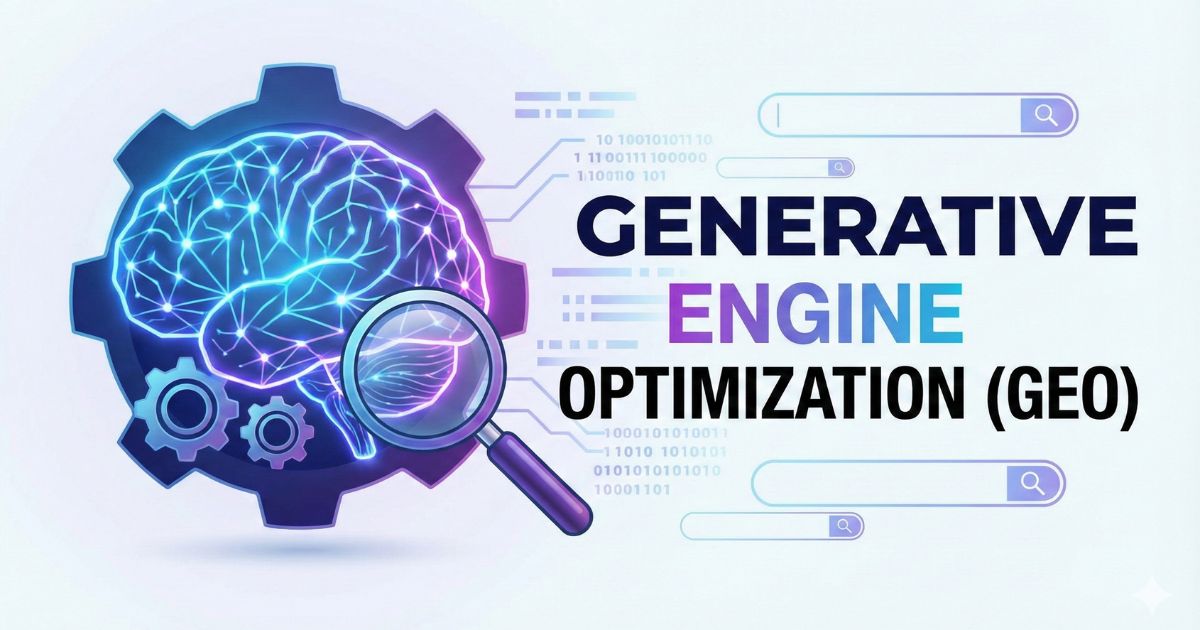
Search is no longer just about ranking websites—it is about being referenced, cited, and recommended by AI systems. As generative AI becomes deeply integrated into search engines, a new optimization discipline has emerged: Generative Engine Optimization (GEO). This shift marks one of the most important changes in the history of search marketing, redefining how businesses gain visibility, authority, and trust online.
Traditional SEO focused on keywords, backlinks, and rankings. While those elements still matter, they are no longer enough. AI-powered search engines now analyze vast datasets, synthesize information, and generate answers directly for users. In this environment, businesses are competing not just for rankings but for inclusion in AI-generated responses. This is where Generative Engine Optimization becomes essential.
In this guide, we’ll explore what GEO is, how it differs from traditional SEO, why it matters, and how businesses can implement GEO strategies to remain visible in the age of AI-driven search.
What Is Generative Engine Optimization (GEO)?
Generative Engine Optimization (GEO) is the process of optimizing content, brand presence, and digital signals so that AI-powered generative search engines can understand, trust, and reference a business when generating answers.
Unlike traditional search engines that rank links, generative engines:
- Analyze context and intent
- Identify trusted entities
- Combine information from multiple sources
- Generate summarized, conversational answers
GEO ensures that your brand becomes one of the trusted sources AI systems rely on when responding to user queries.
In simple terms, SEO helps you rank.
GEO helps AI recommend you.
Why Generative Engine Optimization Is Becoming Essential

The rapid rise of AI-powered search platforms—including Google AI Overviews, Bing Copilot, and ChatGPT-style search interfaces—has fundamentally transformed the way users find and consume information. Instead of navigating multiple websites, users increasingly receive direct, AI-generated answers. This shift is changing the rules of online visibility: businesses are no longer just competing for rankings—they must also ensure they are recognized, cited, and trusted by AI systems.
Generative Engine Optimization matters now more than ever because:
-
AI answers reduce traditional organic clicks: Users often get the information they need directly from AI summaries, decreasing the importance of classic click-through traffic.
-
Only a small number of trusted sources are cited: Generative engines rely on verified, authoritative sources to construct answers. Being one of those sources significantly increases brand exposure.
-
AI recommendations strongly influence user decisions: Businesses referenced by AI are seen as credible, making these recommendations highly impactful on consumer trust and conversions.
-
Brands not recognized by AI risk becoming invisible: If a business fails to establish authority and trust in AI systems, it may be overlooked entirely—even if it ranks on traditional search pages.
By adopting GEO early, businesses can gain a strategic competitive advantage. They position themselves as part of the AI’s trusted knowledge base, increasing their chances of being cited, recommended, and ultimately chosen by users in an AI-driven search ecosystem.
How Generative Engines Work (And Why GEO Matters)
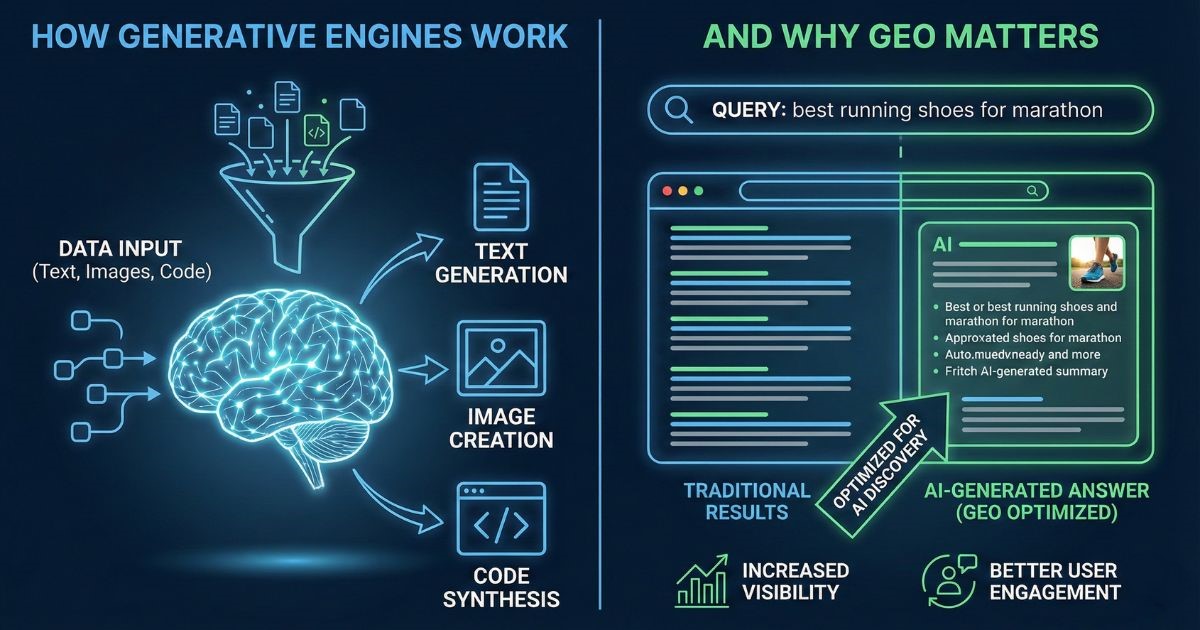
To understand Generative Engine Optimization, it’s important to understand how generative engines function.
Generative engines typically:
- Collect information from trusted sources
- Identify entities such as brands, organizations, and experts
- Evaluate credibility using E-E-A-T signals
- Cross-check facts and consistency
- Generate an answer using selected sources
AI does not choose content randomly. It favors sources that demonstrate experience, expertise, authority, and trustworthiness. GEO aligns your digital presence with these criteria, so AI systems can confidently use your content.
GEO vs Traditional SEO: Key Differences
| Aspect | Traditional SEO | Generative Engine Optimization |
|---|---|---|
| Primary Goal | Rankings | AI citations & recommendations |
| Focus | Keywords | Entities, trust, context |
| Traffic Model | Click-based | Answer-based |
| Authority Signal | Backlinks | Mentions, credibility, consistency |
| Content Style | Optimized pages | Expert, experience-driven content |
Traditional SEO is still important, but GEO builds on top of SEO, extending optimization into AI-driven discovery.
The Role of E-E-A-T in Generative Engine Optimization
E-E-A-T is the foundation of Generative Engine Optimization. AI systems rely heavily on these signals to determine whether a source is safe and reliable to cite.
Experience
AI favors content written from real-world experience. Case studies, practical examples, and first-hand insights significantly strengthen GEO performance.
Expertise
Demonstrated subject-matter knowledge through in-depth, accurate content signals expertise to generative engines.
Authoritativeness
Mentions in reputable publications, industry recognition, and consistent brand presence increase authority.
Trustworthiness
Clear authorship, transparent business information, accurate claims, and genuine reviews improve trust.
Without strong E-E-A-T signals, GEO efforts will struggle to succeed.
Content Strategy for Generative Engine Optimization
Content remains central to GEO, but the approach must change. Generative engines do not favor thin or purely keyword-focused content. Instead, they prioritize clear, structured, and authoritative explanations.
Effective GEO content should:
- Answer real user questions directly
- Use natural, conversational language
- Provide factual accuracy and clarity
- Include structured sections and FAQs
- Demonstrate real expertise
Long-form content that explains topics comprehensively is more likely to be used by AI when generating answers.
Entity Optimization: A Core GEO Principleq
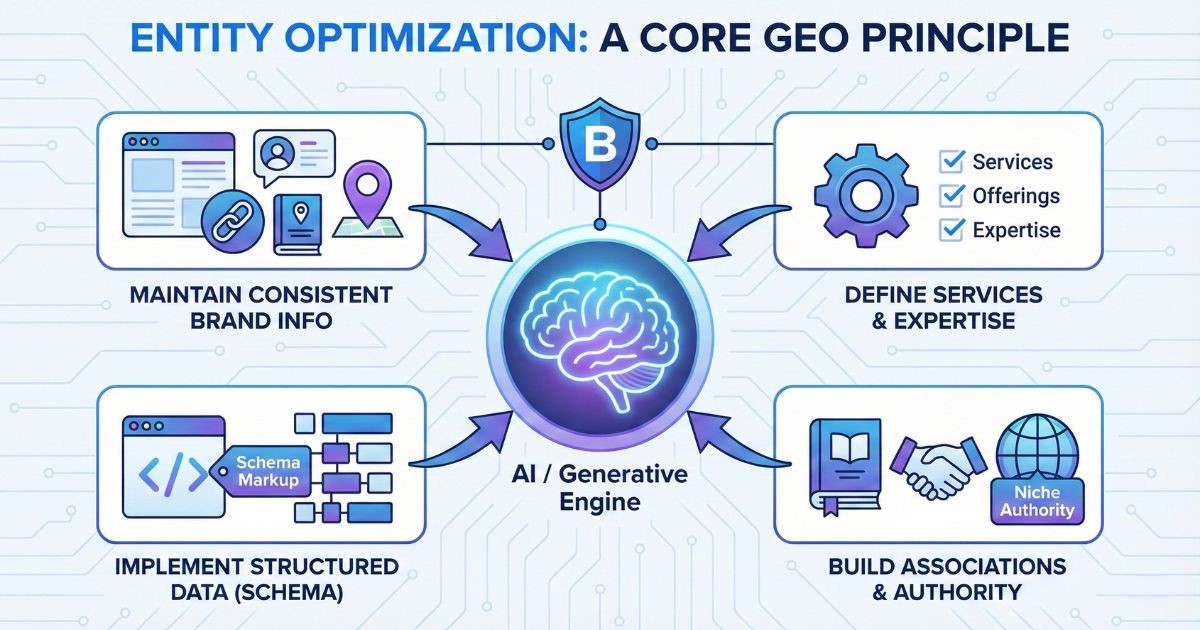
Generative Engine Optimization is closely linked to entity-based SEO, as AI systems need to clearly understand who you are, what you do, and how your brand relates to specific topics or industries. Without strong entity signals, generative engines may struggle to reference your business accurately in answers.
To strengthen entity recognition, businesses should:
- Maintain consistent brand information across all platforms, including website, directories, social profiles, and Google Business Profile
- Clearly define services, expertise, and offerings to help AI categorize your business effectively
- Implement structured data (schema markup) to provide explicit context about your brand, products, and services
- Build associations with relevant topics, industries, and locations to establish authority within your niche
By focusing on entity optimization, businesses ensure that AI systems can confidently connect their brand to relevant queries, improving the likelihood of being recommended or cited in generative search results.
Structured Data and GEO
Structured data plays a critical role in Generative Engine Optimization. Schema markup provides explicit context that reduces ambiguity for AI systems.
Key schema types for GEO include:
- Article
- FAQ
- Organization
- LocalBusiness
- Product / Service
Properly structured data improves eligibility for AI summaries, featured answers, and voice search responses.
Generative engines are conversational by nature. Queries are often phrased as questions rather than keywords. GEO strategies must therefore align with how users speak and ask questions.
Content optimized for GEO should:
- Include question-based headings
- Use FAQ sections
- Provide concise, direct answers
- Match natural language patterns
This makes it easier for AI to extract and present your content.
Common Mistakes That Hurt Generative Engine Optimization
Many businesses unintentionally weaken their Generative Engine Optimization efforts by continuing to rely on outdated or surface-level SEO tactics. While these approaches may have worked in the past, generative search engines are far more selective and trust-driven.
Some of the most common GEO mistakes include:
- Keyword stuffing, which disrupts content quality and signals manipulation to AI systems
- Publishing generic AI-generated content without human review reduces accuracy and originality
- Lack of clear author or business credibility makes it difficult for AI to assess expertise
- Inconsistent brand information across websites, directories, and platforms
- Ignoring structured data, which helps generative engines understand content context
- Over-reliance on backlinks alone, without building real-world authority or trust signals
Generative engines are specifically designed to detect low-quality, repetitive, or untrustworthy content. Businesses that fail to prioritize accuracy, experience, and consistency are far less likely to be included—or recommended—in AI-generated answers.
Measuring Success in GEO
Unlike traditional SEO, GEO success is not measured only by rankings or traffic. Key indicators include:
- Brand mentions in AI answers
- Visibility in AI summaries
- Increased branded searches
- Higher-quality leads
- Improved trust and authority
Over time, strong GEO signals lead to sustainable visibility even as search interfaces evolve.
The Future of SEO Is GEO
Generative Engine Optimization is not replacing SEO—it is evolving it. As AI increasingly controls how information is discovered and delivered, businesses must move beyond ranking-focused tactics and prioritize trust, authority, and credibility.
In AI-powered search environments, fewer sources are selected to generate answers. This means visibility will concentrate around brands that AI systems recognize as reliable and accurate. Businesses with real expertise, consistent brand signals, and proven experience will gain repeated exposure, while weak or generic content will gradually disappear.
Authority in GEO compounds over time. Once a brand earns AI trust, it becomes easier to be referenced again, creating long-term visibility that is more stable than traditional rankings. This shift favors businesses that invest early in quality content, transparency, and real-world relevance.
Companies that adopt Generative Engine Optimization now will be better prepared for an AI-driven search future—where being trusted matters more than being indexed.
Final Thoughts
Generative Engine Optimization (GEO) is no longer optional. As search engines become answer engines, businesses must adapt or risk becoming invisible. GEO shifts the focus from rankings to recognition, trust, and authority.
Brands that prioritize real experience, expert content, consistent entities, and transparent credibility will be the ones AI systems choose to cite. In a future dominated by generative search, being trusted matters more than being ranked.
Ready to Optimize for the Future of Search?
As the search landscape continues to evolve with Generative Engine Optimization (GEO), it’s crucial for businesses to stay ahead of the curve. At SanMo AE, we specialize in helping businesses harness the power of GEO to ensure their brand is recognized, trusted, and recommended by AI systems.
Our team of experts will work with you to implement cutting-edge GEO strategies, ensuring that your content, brand presence, and digital signals align with the latest search engine trends. By combining GEO with traditional SEO, we help you increase your visibility, authority, and trust in the AI-driven search ecosystem.
Get ahead of the competition—don’t let your brand get left behind.
Contact SanMo AE today to learn how our GEO-focused services can give you a competitive edge in the AI-powered search landscape. Whether you’re looking to optimize your existing content or need help building a full-fledged GEO strategy, we’re here to support your business every step of the way.
Frequently Asked Questions
1. What is Generative Engine Optimization (GEO)?
Generative Engine Optimization (GEO) is the strategic process of optimizing digital content, brand presence, and authority signals so that AI-powered search engines and generative platforms can clearly understand, trust, and reference a business when generating answers. Unlike traditional SEO, which focuses primarily on ranking webpages in search results, GEO ensures that your brand becomes a reliable knowledge source for AI systems such as Google AI Overviews, Bing Copilot, and conversational search engines. GEO combines expert-level content, entity clarity, structured data, and trust signals to increase the likelihood that AI tools will cite or recommend your business in response to user queries.
2. Is GEO different from SEO?
Yes, Generative Engine Optimization is different from traditional SEO, although the two work best together. SEO is mainly focused on keywords, backlinks, technical performance, and ranking positions on search engine results pages. GEO, on the other hand, focuses on how AI systems select, interpret, and summarize information. Instead of competing only for rankings, GEO helps businesses compete for visibility inside AI-generated answers, where fewer sources are selected. In modern search environments, ranking alone is no longer enough—GEO ensures your content is structured, credible, and authoritative enough for AI to reference confidently.
3. Do small businesses need GEO?
Absolutely. In fact, Generative Engine Optimization can be especially beneficial for small and local businesses. AI search engines often prioritize clear expertise, local relevance, and trustworthy information over large brand size. A small business that demonstrates real-world experience, accurate information, and consistent branding can outperform larger competitors in AI-generated responses. GEO allows small businesses to gain visibility even when traditional rankings are dominated by big brands, making it a powerful equalizer in the AI search era.
5. Does GEO replace traditional SEO?
No, GEO does not replace traditional SEO—it extends and evolves it. Core SEO elements such as technical optimization, content quality, and site structure remain important foundations. However, GEO adds an additional layer by focusing on entity recognition, authority signals, and AI-readability. Think of SEO as helping search engines find and rank your website, while GEO helps AI systems understand, trust, and recommend your brand. Businesses that combine strong SEO fundamentals with GEO strategies are best positioned for long-term visibility.
6. How long does GEO take to show results?
Generative Engine Optimization is a long-term investment rather than a quick win. Some early signals, such as improved content clarity or increased brand mentions, may appear within a few months. However, meaningful AI visibility and authority typically build gradually over time as generative engines collect and validate trust signals. Consistent expert content, reputable mentions, and strong E-E-A-T signals compound in value, making GEO more effective the longer it is implemented. Businesses that stay consistent often gain sustainable visibility that is difficult for competitors to replicate.