

Marketing attribution helps businesses understand which marketing activities contribute to customer engagement, lead generation, and sales. When a customer discovers a company through search engines, reads a blog post, clicks an advertisement, and later converts through an email campaign, it can be difficult to determine which interaction deserves credit for the result. Marketing attribution provides a structured way to analyze these touchpoints and understand how different channels work together throughout the customer journey.
For modern businesses, this understanding is essential. Marketing budgets are often distributed across search engine optimization, paid advertising, social media, email campaigns, content marketing, and other promotional activities. Without reliable attribution, companies may invest more heavily in channels that appear successful while overlooking the earlier interactions that helped customers make their decisions.
Effective marketing attribution is not simply about assigning credit to a single click. It involves understanding customer behavior, measuring meaningful interactions, and interpreting performance data in the context of broader business objectives. When used thoughtfully, it helps organizations make better budget decisions, improve campaign planning, and develop a clearer picture of how marketing contributes to sustainable growth.
Why Marketing Attribution Matters Beyond Conversion Tracking

A conversion usually represents the completion of a desired action, such as submitting a contact form, requesting a consultation, purchasing a product, or subscribing to a service. Conversion tracking records these actions, but it does not always explain the marketing interactions that influenced them.
Consider a potential customer who first discovers a company through an organic search result. Several days later, the person reads an educational article, visits the company’s social media profile, and eventually clicks a paid advertisement before making an inquiry. A basic tracking system might credit the final advertisement with the entire conversion. However, the earlier interactions may have introduced the company, established credibility, and encouraged further research.
Marketing attribution provides a broader perspective by examining the contribution of different touchpoints. It helps marketers understand whether a channel primarily creates awareness, supports consideration, encourages conversion, or contributes to several stages of the buying process.
This distinction matters because marketing activities rarely operate independently. Educational content may influence purchasing decisions without generating immediate sales. Paid advertising may bring customers back to a website after they have already encountered the brand elsewhere. Email campaigns may help prospects remain engaged while they compare alternatives.
By analyzing these relationships, businesses can avoid evaluating every channel through the same narrow measurement. They can make decisions based on how marketing activities contribute to the overall customer journey rather than focusing exclusively on the last interaction before conversion.
Understanding Marketing Attribution Models
Marketing attribution models determine how conversion credit is distributed among the interactions that occur before a desired action. Different models emphasize different parts of the customer journey, which means the same campaign can appear more or less valuable depending on the model being used.
A first-touch attribution model assigns credit to the first recorded marketing interaction. It can help businesses understand which channels introduce new audiences to their brand. This perspective is particularly useful when examining awareness campaigns, organic discovery, and initial customer acquisition.
A last-touch attribution model gives credit to the final recorded interaction before conversion. It is straightforward to understand and can help identify the channels that frequently appear immediately before a purchase or inquiry. However, it may undervalue earlier marketing activities that influenced the decision.
A linear attribution model distributes credit evenly across the recorded touchpoints. This approach recognizes that customers often interact with several channels before converting, although it assumes that every interaction contributes equally.
Time-decay attribution gives more weight to interactions that occur closer to the conversion, while position-based models assign greater importance to selected stages, such as the first and last touchpoints. These approaches provide different perspectives on the same journey.
No single model is universally correct. A business focused on brand awareness may benefit from first-touch analysis, while a company examining the interactions involved in longer sales cycles may prefer a multi-touch approach. The most useful model is the one that aligns with the business question and the available evidence.
The Role of Multi-Touch Attribution in Complex Customer Journeys
Multi-touch attribution recognizes that customers frequently interact with several marketing channels before making a decision. Rather than assigning all credit to one interaction, it attempts to represent the contributions of multiple touchpoints throughout the journey.
This approach is especially relevant for businesses with longer sales cycles. A prospective customer may discover a brand through search, read several articles, attend a webinar, receive follow-up emails, and speak with a sales representative before purchasing. Each interaction can serve a different purpose, and the importance of that interaction may vary by customer.
Multi-touch analysis can help marketing teams identify patterns across these journeys. For instance, they may discover that educational content often appears early in successful customer journeys, while email engagement and direct website visits are common closer to conversion. Such patterns can inform content planning, campaign sequencing, and channel investment.
However, the model depends on the quality and completeness of the available data. Interactions that occur across different devices, offline conversations, private browsing sessions, or unconnected systems may not be captured. As a result, the recorded journey may represent only part of the customer’s actual experience.
Attribution also does not automatically prove that a marketing interaction caused a conversion. A customer might have purchased regardless of whether a particular advertisement was shown. Multi-touch attribution is therefore most useful when combined with careful interpretation, consistent measurement, and, where appropriate, experiments that test whether marketing activity creates incremental results.
Marketing Channel Attribution and Budget Allocation
Marketing channel attribution helps organizations evaluate how different channels contribute to business outcomes. These channels may include organic search, paid search, social media, email, referral traffic, display advertising, and content marketing.
The challenge is that each channel can perform a different function. Organic search may attract people looking for answers, while paid search can capture demand from users actively comparing services. Social media may introduce a brand to new audiences, and email can maintain engagement with people who have already shown interest.
A channel that generates fewer direct conversions may still contribute to the success of other channels. For example, a useful article may introduce a prospect to a business, but the final conversion may occur after the prospect returns through a branded search or a paid campaign. If the business only evaluates the last interaction, it may reduce investment in content that supports the wider journey.
Effective channel analysis considers more than conversion volume. Cost per acquisition, lead quality, revenue contribution, conversion rates, engagement patterns, and the time required to convert can all provide valuable context. These measures help businesses determine whether a channel attracts the right audience and contributes to commercial objectives.
Budget decisions should also account for channel costs and diminishing returns. Increasing spending may initially produce more conversions, but the additional results may become less efficient as competition increases or the audience becomes saturated. Attribution data can identify promising opportunities, while controlled budget tests help establish whether additional investment is worthwhile.
Customer Journey Attribution and the Importance of Context
Customer journey attribution examines how people move from their first interaction with a business to later engagement and conversion. It connects marketing touchpoints with the stages of customer decision-making, providing a more complete view of how awareness develops into action.
The journey may begin long before a prospect visits a landing page. A person might encounter a social media discussion, hear about a company from a colleague, or read an independent review before searching for the brand online. Some of these interactions may be visible in analytics systems, while others remain difficult to measure.
This is why attribution reports should be interpreted alongside qualitative information about customer behavior. Sales conversations, customer surveys, feedback forms, and research into buying preferences can help explain why certain interactions appear important. They can also reveal influential touchpoints that digital tracking does not capture.
For reputation-sensitive businesses, trust can be a meaningful part of the journey. Potential customers may research a company’s reputation, examine public feedback, and look for evidence that the business responds responsibly to concerns. A thoughtful approach to handling negative comments can support confidence in the brand, even when the effect does not appear as a direct conversion in an attribution report.
Similarly, consistent reputation management can influence how prospects evaluate a business before making contact. These activities demonstrate why customer journey analysis should consider the wider experience surrounding a conversion rather than relying exclusively on the final click.
Digital Marketing Attribution and Data Quality
Digital marketing attribution depends on accurate, consistent data. Tracking systems need to record important interactions, connect them to relevant campaigns, and distinguish between meaningful conversions and routine website activity.
Campaign tagging is one important part of this process. Consistent tracking parameters help analytics systems identify the source, medium, and campaign associated with a visit. Without standardized naming conventions, the same campaign may appear under several different labels, making comparisons unreliable.
Conversion definitions also need careful attention. A newsletter subscription, a qualified sales inquiry, and a completed purchase represent different levels of business value. Treating them as equivalent conversions can create misleading reports, particularly when one channel generates many low-intent actions and another generates fewer but more valuable opportunities.
Data quality issues can also arise when multiple systems record the same event, when tracking scripts fail, or when customer interactions are not connected across platforms. Marketing teams should periodically review their tracking setup, verify important events, and investigate unexpected changes in reporting.
Privacy requirements must remain part of the measurement process. Businesses should use appropriate consent mechanisms, respect user choices, limit unnecessary data collection, and follow the laws applicable to their activities. Attribution systems may operate with incomplete data because some users decline tracking or because certain platforms restrict data sharing.
Reliable attribution does not require collecting every possible detail about every individual. It requires gathering appropriate information, defining metrics consistently, and understanding the limitations of the data being analyzed.
Connecting Attribution With SEO and Content Performance
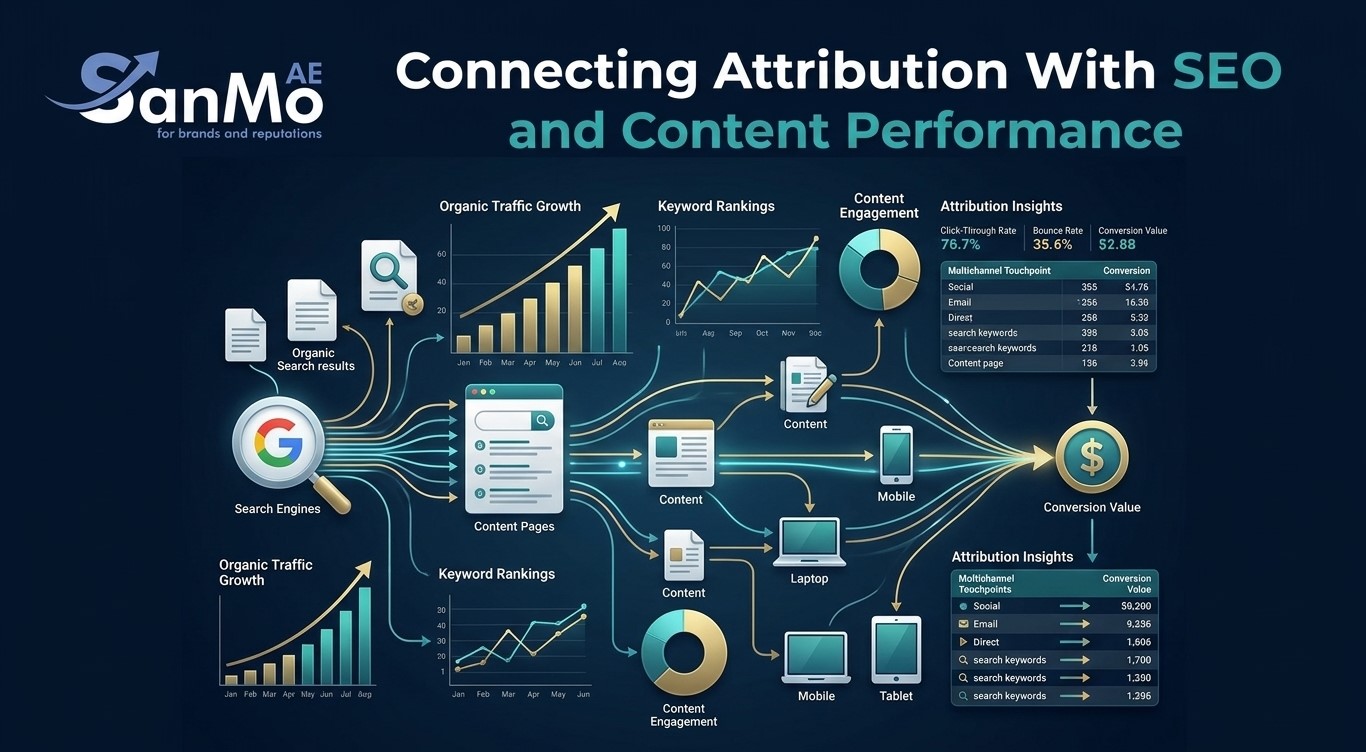
Search engine optimization often contributes to several stages of the customer journey. A prospect may find an educational article through an informational query, return later through a commercial search, and eventually convert after visiting a service page. If the business only credits the final interaction, the contribution of earlier organic content may be overlooked.
Attribution can help marketers examine how organic search interacts with other channels. They can assess which landing pages frequently appear in converting journeys, which content attracts returning visitors, and how organic traffic contributes to assisted conversions. These insights can guide decisions about content development and website improvements.
However, attribution should not replace technical and strategic SEO analysis. Rankings, search visibility, relevant organic traffic, page experience, and content relevance remain important indicators. A page that appears in many customer journeys may deserve further investigation, but its presence alone does not prove that it caused those conversions.
Businesses investing in advanced SEO services can use attribution alongside search performance data to better understand how organic discovery supports lead generation and revenue. Connecting these measurements provides a more useful view of SEO’s contribution than evaluating rankings or last-click conversions in isolation.
The same principle applies to content marketing. Educational resources, comparison pages, case studies, and service descriptions can influence different stages of the decision-making process. Understanding their respective roles helps organizations build content that supports the complete journey rather than concentrating only on pages that produce immediate conversions.
Marketing ROI Attribution and Financial Accountability
Marketing ROI attribution connects marketing activity with financial outcomes. It helps organizations evaluate whether their investments contribute sufficient business value to justify the associated costs.
A basic return-on-investment calculation compares the financial return from an activity with its cost. However, attribution introduces an important challenge: when several channels contribute to a sale, assigning the entire revenue amount to each channel would overstate performance. The business must use a consistent method to distribute credit or analyze overall results without double-counting.
For example, a company might use a multi-touch model to allocate part of a conversion’s value to organic search, another portion to email, and another to paid advertising. This provides a structured comparison, but the allocated values remain estimates based on the selected model rather than definitive proof of causal contribution.
Financial analysis should also account for profit margins, acquisition costs, sales-cycle length, and the value of customers over time. A campaign that generates a high volume of leads may be less valuable than one that attracts fewer prospects who are more likely to become profitable customers.
Media costs are another important factor. Organizations using media buying services can compare advertising expenditure with attributed conversions, lead quality, and downstream revenue. This helps teams understand whether paid campaigns are delivering useful results and where adjustments may be needed.
Ultimately, marketing ROI attribution should support decisions about future investment. Combining financial reporting with channel analysis and controlled testing creates a stronger basis for deciding which activities deserve additional funding.
Data-Driven Marketing Attribution in Practice
Data-driven marketing attribution combines customer interaction data, campaign performance information, and business outcomes to develop a more evidence-based understanding of marketing effectiveness. It is most useful when organizations begin with specific questions rather than attempting to measure every possible interaction.
A business might want to know whether organic content contributes to qualified leads, whether paid advertising brings in new customers, or whether email nurturing improves conversion rates among existing prospects. Each question requires a suitable measurement approach and a clear definition of success.
The process begins with consistent data collection and agreed conversion definitions. Marketing teams then select an attribution model that matches the question, analyze the results, and examine whether the findings remain consistent across time periods and audience segments.
It is also important to distinguish correlation from causation. A channel may frequently appear in successful customer journeys without being responsible for the outcome. Incrementality tests, controlled experiments, and carefully designed comparisons can help estimate whether a marketing activity produces additional results beyond what would have occurred otherwise.
Attribution insights should lead to practical decisions. These may include improving campaign targeting, changing content priorities, adjusting channel budgets, or investigating stages where prospects frequently disengage. Teams should monitor the effects of these changes rather than assuming that an initial insight will remain valid indefinitely.
A mature approach treats attribution as an evolving analytical capability. As channels, customer behavior, privacy requirements, and business objectives change, measurement methods should be reviewed and refined accordingly.
Common Marketing Attribution Challenges

Despite its benefits, marketing attribution has several limitations. One of the most common is incomplete customer journey data. People switch devices, use different browsers, interact offline, or move between platforms that do not share information. These gaps can make it difficult to connect every touchpoint to a conversion.
Another challenge is choosing an attribution model that favors certain channels. Last-touch models may overemphasize channels that capture existing demand, while first-touch models may underrepresent the interactions that help prospects complete a purchase. Multi-touch models provide a broader perspective but depend on assumptions about how credit should be distributed.
Long sales cycles create additional complexity. A marketing interaction may occur weeks or months before a purchase, and the influence of that interaction can be difficult to measure precisely. Businesses should select reporting windows that reflect their actual buying process rather than relying on arbitrary periods.
Organizational silos can also undermine attribution. When advertising, SEO, email, sales, and customer relationship management systems are managed separately, data may be inconsistent or difficult to connect. Shared definitions and collaboration between departments help improve the reliability of the analysis.
Finally, attribution can create a false sense of precision. A report may display exact percentages or revenue allocations, but those figures are still shaped by tracking coverage and model assumptions. Businesses should use them as decision-support evidence, not as unquestionable measurements of causation.
Conclusion
Marketing attribution helps businesses understand how different marketing interactions contribute to customer engagement, lead generation, and revenue. By selecting appropriate attribution models, improving data quality, and examining the complete customer journey, organizations can gain a clearer understanding of marketing performance.
The most effective approach combines attribution with conversion tracking, financial analysis, channel reporting, and customer insights. It recognizes that different activities serve different purposes and that no single model can fully explain every purchase decision.
When businesses interpret attribution results carefully and validate important findings through testing, they can allocate budgets more intelligently, improve campaign coordination, and identify opportunities for sustainable growth. Rather than simply deciding which channel receives credit, marketing attribution helps organizations understand how their marketing efforts work together to create business value.
Frequently Asked Questions
1. What is marketing attribution?
Marketing attribution is the process of analyzing how different marketing interactions contribute to a conversion, lead, sale, or other business outcome.
2. Why is marketing attribution important?
It helps businesses understand channel contributions, evaluate campaign performance, allocate budgets more effectively, and identify opportunities to improve customer acquisition.
3. What are the main marketing attribution models?
Common models include first-touch, last-touch, linear, time-decay, position-based, and data-driven attribution. Each model distributes conversion credit differently.
4. What is multi-touch attribution?
Multi-touch attribution evaluates multiple interactions throughout the customer journey instead of assigning all conversion credit to a single touchpoint.
5. How does marketing attribution differ from conversion tracking?
Conversion tracking records actions such as purchases or form submissions. Marketing attribution analyzes how marketing interactions contributed to those actions.
6. How does attribution help improve marketing ROI?
It provides a framework for comparing channel contributions with campaign costs and business outcomes, helping teams make more informed investment decisions.
7. Can marketing attribution identify the exact cause of a sale?
Not always. Attribution models distribute credit based on recorded interactions and specific assumptions. Controlled experiments may be needed to estimate whether a marketing activity caused additional conversions.
8. How does SEO contribute to marketing attribution?
SEO can introduce prospects to a business and support later conversions through educational content, service pages, and organic search visibility. Attribution helps reveal how these interactions appear in customer journeys.
9. What challenges affect marketing attribution accuracy?
Common challenges include incomplete tracking, inconsistent campaign tagging, cross-device behavior, privacy restrictions, disconnected systems, and the limitations of individual attribution models.
10. How can a business improve its marketing attribution process?
Businesses can establish clear conversion definitions, standardize campaign tracking, improve data quality, select appropriate models, connect marketing and sales information, and validate findings through testing.