Software-as-a-Service (SaaS) has transformed how businesses operate, offering scalable solutions that reduce costs and improve efficiency. Yet many companies struggle to create SaaS products that truly meet their users’ needs and scale effectively.
Building successful SaaS applications requires more than just coding skills. It demands expertise in cloud architecture, user experience design, security protocols, and ongoing maintenance strategies. Professional SaaS development services bridge this gap, providing the specialized knowledge and resources needed to create robust, scalable software solutions.
Whether you’re a startup looking to launch your first SaaS product or an established enterprise seeking to modernize your software offerings, understanding what professional development services can offer is crucial for your success.
What Are SaaS Development Services?
SaaS development services encompass the complete process of designing, building, and maintaining cloud-based software applications. Unlike traditional software development, SaaS development focuses on creating applications that are:
- Hosted in the cloud and accessible via web browsers
- Scalable to handle varying user loads
- Multi-tenant, allowing multiple customers to use the same application securely
- Subscription-based with recurring revenue models
Professional SaaS development teams handle everything from initial concept validation to ongoing support and feature updates. They bring together diverse expertise in areas like cloud infrastructure, database design, API development, and user interface creation.
Core Components of Professional SaaS Development
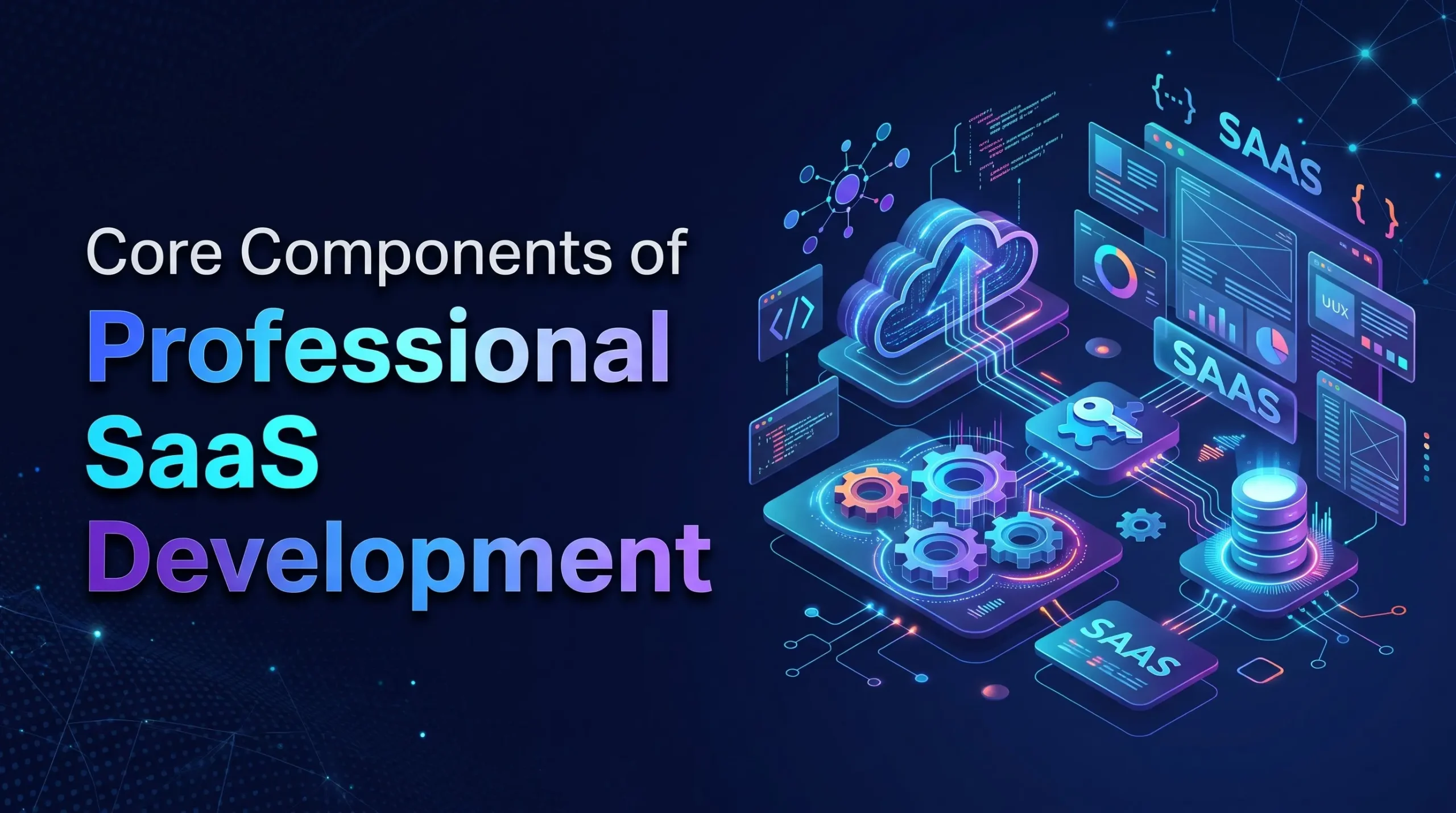 Professional SaaS development involves several interconnected components that determine an application’s performance, security, usability, and long-term scalability. From selecting the right cloud infrastructure to implementing strong security measures and designing an intuitive user interface, every component plays an important role in creating a reliable software product
Architecture and Infrastructure Planning
The foundation of a successful SaaS application lies in its architecture and infrastructure. Professional developers design systems that can handle increasing user demand, maintain consistent performance, and support future feature expansion. This includes: Cloud infrastructure provides the computing power, storage, databases, and networking services required to operate a SaaS application. Developers configure cloud environments based on application requirements, expected traffic, and budget.
Multi-tenant architecture enables multiple customers to use the same application infrastructure while maintaining appropriate separation between their data and access permissions. This approach can reduce maintenance costs and simplify software updates. Load balancing distributes incoming application traffic across multiple servers or service instances. This helps prevent individual servers from becoming overloaded and improves application availability during periods of high demand.
Security Implementation
Security is a critical component of professional SaaS development because applications frequently process customer information, business records, payment details, and other sensitive data. Developers must incorporate security throughout the development lifecycle rather than treating it as a final step. A comprehensive security strategy helps prevent unauthorized access, reduce vulnerabilities, and strengthen customer confidence in the software.
User Experience Design
User experience design determines how easily customers can understand, navigate, and benefit from a SaaS application. Even technically advanced software can struggle to retain users if its interface is confusing or its essential features are difficult to find. Professional SaaS development services prioritize usability, accessibility, and consistency to create an experience that encourages adoption and long-term customer engagement.
Benefits of Professional SaaS Development Services
Faster Time to Market
Launching a SaaS product at the right time can provide a significant competitive advantage. Professional development teams use established workflows, proven frameworks, reusable components, and agile methodologies to streamline the development process. They can identify technical challenges early, prioritize essential features, and reduce unnecessary delays during implementation.
Cost-Effective Scaling
As a SaaS business grows, its software must accommodate increasing users, larger data volumes, and more complex operational requirements. Professional developers design applications with scalability in mind, helping businesses expand their infrastructure without requiring expensive architectural changes or complete system rebuilds.
Access to Specialized Expertise
SaaS development requires expertise across multiple technical disciplines, including cloud computing, software architecture, cybersecurity, database management, and user experience design. Professional development services give businesses access to specialists who understand how these components work together. This reduces the need to recruit an entire in-house technical team and helps organizations make better technology decisions.
Ongoing Support and Maintenance
Launching a SaaS product is only the beginning of its lifecycle. Applications require continuous monitoring, regular updates, security improvements, and technical support to remain reliable and competitive. Professional SaaS development services help businesses maintain software quality while adapting to changing customer expectations and technology requirements.
Key Technologies in Modern SaaS Development
Cloud Platforms and Services
Cloud platforms provide the infrastructure required to host SaaS applications, store data, manage computing resources, and deliver services to users across different locations. Instead of maintaining physical servers, businesses can use cloud-based resources that scale according to demand. Popular choices include:
Amazon Web Services (AWS) offers a broad range of cloud services for application hosting, database management, storage, networking, and machine learning integration. SaaS developers can use AWS services to build scalable infrastructure, automate deployment processes, and manage changing workloads.
Microsoft Azure is a strong option for organizations that rely on Microsoft technologies and enterprise software. It supports cloud hosting, identity management, application development, and hybrid cloud environments that combine on-premises infrastructure with cloud services. Azure can help businesses integrate SaaS applications with existing enterprise systems while maintaining centralized management and security controls.
Google Cloud Platform (GCP) provides cloud infrastructure alongside specialized services for data analytics, artificial intelligence, and machine learning. Its data processing and analytics capabilities can help SaaS businesses understand user behavior, generate insights, and develop intelligent application features. Google Cloud is particularly useful for products that depend on data-driven functionality and advanced analytical workloads.
Development Frameworks and Languages
Professional SaaS development teams use proven frameworks and languages optimized for web applications:
- React and Angular are widely used for front-end development. React supports the creation of reusable interface components, making it useful for interactive dashboards, customer portals, and data-driven applications. Angular provides a more structured framework with built-in tools for developing complex web applications. Both technologies can help teams create responsive interfaces that work across different screen sizes and devices.
- For backend development, Node.js, Python, and Ruby on Rails offer different advantages. Node.js is suitable for applications that handle numerous concurrent requests and real-time interactions. Python supports rapid development and offers extensive libraries for data processing, automation, and artificial intelligence features. Ruby on Rails provides established conventions and development tools that can help teams build functional web applications efficiently.
- Docker and Kubernetes support containerization and deployment. Docker packages an application and its dependencies into containers, helping maintain consistent behavior across development, testing, and production environments. Kubernetes helps manage containerized applications by coordinating deployment, scaling, recovery, and resource allocation across infrastructure. Together, these technologies can improve deployment consistency and operational efficiency, particularly for larger SaaS platforms.
Database Solutions
Choosing the right database architecture is crucial for SaaS applications. Options include:
- Relational databases such as PostgreSQL organize information into structured tables with defined relationships. They support SQL queries and transactions, making them suitable for applications that require data consistency and reliable transaction processing. PostgreSQL is commonly used for financial records, user accounts, subscription management, and other structured business information. Its advanced querying capabilities also support complex application requirements.
- NoSQL databases such as MongoDB are designed to handle flexible data structures and document-oriented information. They can be useful when an application manages varying data formats, product catalogs, user-generated content, or information that changes frequently during development. Depending on the data model and workload, a NoSQL database can provide flexibility for evolving application requirements. However, developers must still evaluate consistency, indexing, and query performance before choosing this approach.
- Data warehouses such as Snowflake are designed for analytical workloads rather than serving every application transaction directly. They help businesses consolidate data from multiple sources, run complex queries, and generate reports for business intelligence. SaaS companies can use data warehouses to analyze customer engagement, monitor subscription trends, evaluate product usage, and support data-driven decisions.
Choosing the Right SaaS Development Partner

Technical Expertise Assessment
Evaluate potential development partners based on their technical capabilities:
- Experience with your industry’s specific requirements
- Portfolio of successful SaaS applications
- Knowledge of current best practices and emerging technologies
- Ability to integrate with existing systems and third-party services
Development Methodology
Professional SaaS development services typically use agile methodologies that allow for iterative development and regular feedback. Look for teams that:
- Provide regular progress updates and demonstrations
- Allow for changes and refinements throughout the development process
- Have established quality assurance and testing procedures
Post-Launch Support Capabilities
The relationship with your development partner shouldn’t end at launch. Ensure they can provide:
- 24/7 monitoring and support services
- Regular maintenance and security updates
- Scalability planning and implementation
- Feature development and enhancement services
Planning Your SaaS Development Project
Requirements Gathering and Validation
Before development begins, professional services help validate your concept through:
- Market research and competitive analysis
- User persona development and journey mapping
- Technical feasibility assessment
- Revenue model validation
Development Timeline and Milestones
Professional SaaS development follows structured timelines with clear milestones:
- Discovery Phase (2-4 weeks): Requirements gathering and project planning
- Design Phase (3-6 weeks): User interface and architecture design
- Development Phase (12-24 weeks): Core application development
- Testing Phase (4-8 weeks): Quality assurance and user testing
- Launch Phase (2-4 weeks): Deployment and go-live activities
Budget Considerations
SaaS development costs vary based on complexity and requirements. Professional services help optimize budgets by:
- Identifying must-have features versus nice-to-have additions
- Recommending cost-effective technology solutions
- Planning development phases to spread costs over time
- Providing accurate estimates based on detailed requirements
Transforming Your Business with Professional SaaS Development
Professional SaaS development services offer more than just technical expertise—they provide a strategic partnership that can transform your business. By working with experienced developers, you gain access to proven methodologies, cutting-edge technologies, and ongoing support that ensures your SaaS application succeeds in the competitive market.
The investment in professional development services pays dividends through faster time to market, reduced development risks, and applications that scale efficiently with your business growth. As you consider your SaaS development needs, focus on finding partners who understand your industry, share your vision, and have the technical capabilities to bring your ideas to life. Ready to explore how professional SaaS development services can benefit your business? Start by clearly defining your requirements and researching development partners who specialize in your industry or application type.
Frequently Asked Questions About SaaS Development Services
1. What Are SaaS Development Services?
SaaS development services involve designing, building, deploying, and maintaining cloud-based software applications. These services help businesses create scalable, secure, and accessible software products that customers can use through subscription-based models.
2. What Are the Benefits of Professional SaaS Development Services?
Professional SaaS development services help businesses reduce development risks, accelerate time to market, improve software security, and support future growth. They also provide access to specialized technical expertise and ongoing maintenance.
3. How Much Does It Cost to Develop a SaaS Application?
The cost of developing a SaaS application depends on its complexity, features, technology stack, security requirements, and development timeline. A detailed project assessment helps businesses estimate expenses and prioritize essential features within their budget.
4. How Long Does It Take to Build a SaaS Application?
SaaS development timelines vary depending on project scope and technical requirements. A simple application may take a few months, while a complex enterprise platform can require six months or longer for development, testing, and deployment.
5. Which Technologies Are Commonly Used in SaaS Development?
Common SaaS development technologies include React and Angular for frontend development, Node.js and Python for backend systems, and PostgreSQL or MongoDB for database management. Cloud platforms such as AWS, Microsoft Azure, and Google Cloud support hosting and scalability.
6. How Do SaaS Development Services Ensure Data Security?
SaaS development services implement security measures such as data encryption, secure authentication, access controls, regular security testing, and continuous monitoring. Depending on the application, developers may also support compliance with relevant standards and regulations.
7. Why Is Scalability Important in SaaS Application Development?
Scalability allows a SaaS application to accommodate increasing users, growing data volumes, and changing business demands without significant performance issues. A scalable architecture helps businesses expand their customer base while maintaining reliability and a positive user experience.
8. What Is Multi-Tenant Architecture in SaaS Development?
Multi-tenant architecture allows multiple customers to use the same software application and underlying infrastructure while keeping their data appropriately isolated. This approach can reduce operational costs, simplify maintenance, and make software updates more efficient.
9. What Should Businesses Consider When Choosing a SaaS Development Partner?
Businesses should evaluate a development partner’s technical expertise, previous projects, security practices, communication process, development methodology, and post-launch support. Transparent pricing and a clear understanding of business objectives are also essential for successful collaboration.
10. Why Do SaaS Applications Need Ongoing Maintenance and Support?
Ongoing maintenance helps SaaS applications remain secure, reliable, and compatible with changing technologies. Regular updates, performance monitoring, bug fixes, and feature enhancements improve user satisfaction and help the application support long-term business growth.